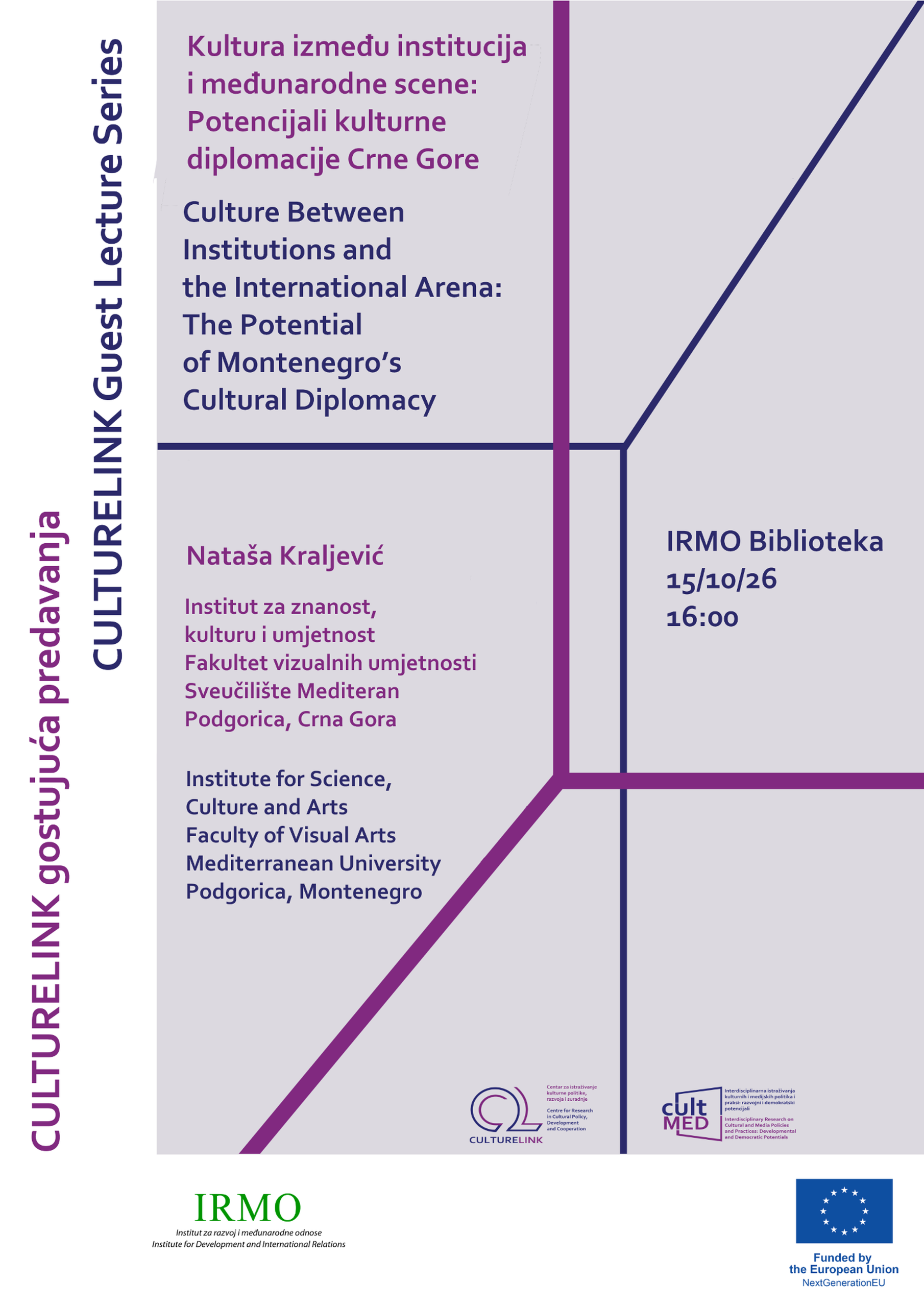
CULTURELINK – Centre for Research in Cultural Policy, Development and Cooperation, within the framework of the CULTMED project, is organising a guest lecture by Assoc. Prof. Nataša Kraljević from Mediterranean University in Podgorica. The lecture, entitled “Culture Between Institutions and the International Arena: The Potential of Montenegro’s Cultural Diplomacy,” will take place on Thursday, 15 October 2026 at 4:00 p.m. at the Library of the Institute for Development and International Relations (IRMO).
The lecture will provide an overview of the current state and development potential of cultural diplomacy in Montenegro, with particular emphasis on its relationship with public cultural policy, the European integration process, and international cultural cooperation. Starting from the historical development of cultural policy, it will examine how the legacy of the Yugoslav model of cultural governance—characterised by the strong role of public institutions and the state in financing and organising cultural life—continues to influence institutional structures, understandings of the role of culture, and relations between the public and independent cultural sectors. Particular attention will be paid to the changes that occurred during the processes of transition, state-building, and European integration.
Kraljević will approach cultural diplomacy as a space for the exchange of ideas, values, and cultural content aimed at developing social and cultural relations and international cultural cooperation. In this context, culture outside formal institutions is assuming an increasingly important role. This issue is particularly relevant in Montenegro due to the country’s size, limited institutional and financial capacities, and the need for greater international cultural visibility.
Cultural diplomacy will therefore not be viewed exclusively as a domain of state institutions, but rather as a space in which the broader cultural ecosystem participates. The lecture will pay particular attention to the relationship between public cultural policy and cultural practice, examining the disparity between the social potential of culture and the ways in which this potential is recognised, valued, and supported through public policies. Although independent cultural actors often have well-developed international networks and significant potential for cultural exchange, their role is not always accompanied by adequate institutional, financial, and strategic support mechanisms.
The lecture will therefore focus on how the historical legacy of cultural policy, the contemporary public policy framework, and relations between institutional and non-institutional culture shape the possibilities for developing Montenegro’s cultural diplomacy. It will also consider the extent to which Montenegro recognises and utilises its existing cultural potential in international communication and in strengthening its cultural visibility, as well as how a model might be developed in which the state, public institutions, and independent cultural actors operate as partners while preserving the autonomy, pluralism, and critical role of culture outside formal institutions.
The guest lecture is organised within the framework of cooperation between IRMO’s Department for Culture and Communication and the Institute for Science, Culture and Arts (ISCA) at Mediterranean University, formalised through a Cooperation Agreement signed in May 2026. Cooperation between the two institutions encompasses joint research projects, publications, and international conferences, as well as the development of new forms of research and professional cooperation in the field of cultural policy.
Participation is open to all interested participants. Registration is required by 14 October via email at kultura@irmo.hr.