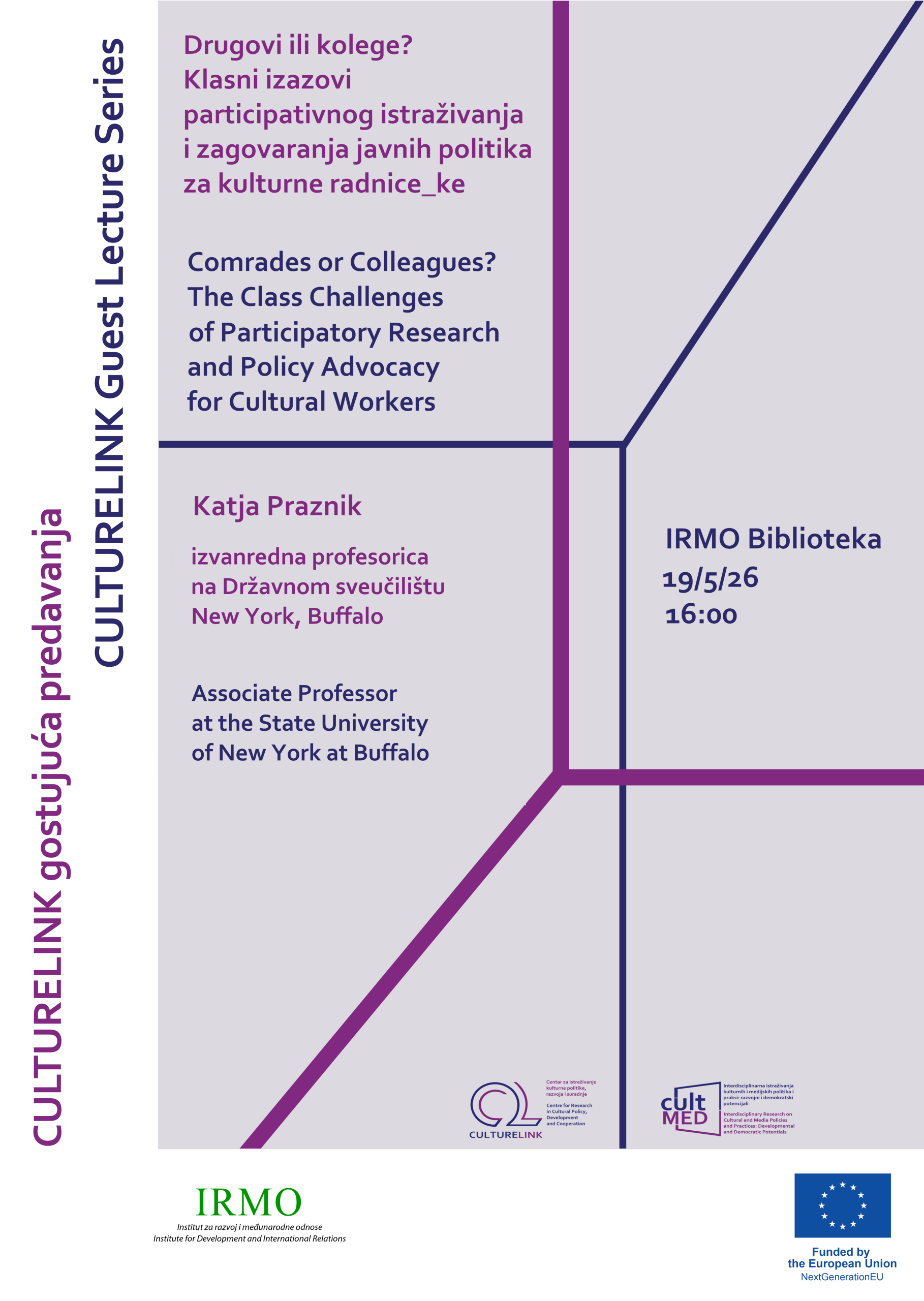
As part of the CULTMED project, CULTURELINK – Centre for Research in Cultural Policy, Development and Cooperation, invites you to the eighth lecture in the Culturelink Guest Lecture Series. The lecture will take place on Tuesday, May 19, 2026, at 16h, in the library of the Institute for Development and International Relations (IRMO). Dr Katja Praznik from the State University of New York at Buffalo will give a lecture entitled “Comrades or colleagues? The Class Challenges of Participatory Research and Policy Advocacy for Cultural Workers”.
What happens when research seeks not only to analyze cultural production, but to intervene in its conditions of labor? This lecture examines the persistent invisibility of labor in the cultural sector through the lens of social reproduction analyses and participatory research conducted with freelance art workers in the post-Yugoslav context. It argues that artistic labor is systematically essentialized as “creativity”—an individualized expression of passion or talent—thereby obscuring the labor process, normalizing unpaid work, and enabling the extraction of value under precarious conditions.
Drawing on organizing experiences with art workers’ unions in Slovenia and Croatia, the lecture shows how this ideological framing is increasingly challenged through collective action that reasserts art work as labor. At the same time, it critically reflects on the limits of decades of policy advocacy and research, which have extensively documented precarity in the cultural sector yet failed to produce structural change.
The analysis suggests that the central obstacle is not a lack of knowledge, but a lack of organized power capable of transforming entrenched labor relations shaped by divergent class interests. In this context, participatory research emerges as a politically ambivalent practice: while it can contribute to building collective agency, it also risks being absorbed into institutional frameworks that reproduce the very conditions it seeks to critique.
The lecture ultimately poses a question to researchers and policy actors alike: are we positioned as expert colleagues producing knowledge about cultural workers, or as comrades engaged in struggles to transform the conditions of cultural labor? This tension calls for a reflexive rethinking of the role of research in relation to organizing, class formation, and the future of cultural production.
The lecture is organized in connection with the publication of the new book ‘Creative and Cultural Work in Europe’ edited by Bård Kleppe, Jaka Primorac, Miikka Pyykkönen and David Wright (published by Routledge), and it will be moderated by Dr Jaka Primorac from the Department for Culture and Communication, Institute for Development and International Relations (IRMO).
The lecture will be held in English, and the discussion will be held in Croatian. You can sign up to attend the lecture by May 18 at kultura@irmo.hr.
She is the author of Art Work: Invisible Labor and the Legacy of Yugoslav Socialism (University of Toronto Press, 2021). Her recent contributions to edited volumes—including The Routledge Companion to Marxisms in Art History (Routledge, 2025), Contemporary Art in the Post-Yugoslav Space (Routledge, 2025), and Creative and Cultural Work in Europe (Routledge, 2026)—advance a critique of how artistic labor is systematically devalued and contribute to foregrounding art work exploitation as a central issue in the field of cultural production. She is currently co-editing a special issue of Critical Sociology on art work and organizing, and completing a new book project, Why Artists Don’t Want to Get Paid. She is also a co-founder of the freelance art workers’ union Zasuk in Slovenia.
More information can be found at the following link.