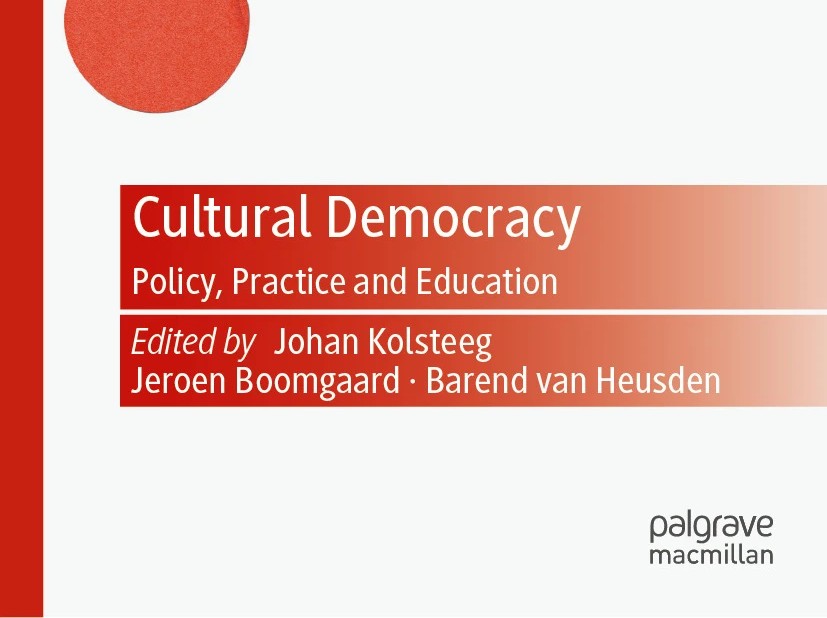
Associates from the Culture and Communication Department and researchers on the CULTMED project, Dr Dea Vidović and Dr Ana Žuvela, are the authors of the scholarly chapter “Democratising Cultural Policy Through Participatory Governance,” published in the edited volume Cultural Democracy: Policy, Practice and Education, by Palgrave Macmillan. The publication was edited by Johan Kolsteeg, Jeroen Boomgaard, and Barend van Heusden.
The chapter examines the relationship between democratic traits and the normative promises of cultural policy versus its actual practice, viewing this relationship through the lens of participatory governance in culture as one of the key contemporary directions in cultural policy development. The authors analyse how participatory models can contribute to democratizing cultural policy by redirecting decision-making from centralized and bureaucratic structures toward shared, context-responsive, and collaborative governance arrangements. Using the concepts of embeddedness, institutionalization, and Participatory Institutional Design, the chapter offers an analysis of Croatian cultural policy with particular emphasis on civil society initiatives and the civil-public institution Pogon (Zagreb) as a fifteen-year case study of participatory governance in practice.
The edited volume Cultural Democracy contains 11 chapters in which authors consider the ramifications of the term ‘cultural democracy’ from a variety of perspectives. In recent years, the concept of cultural democracy has gained traction in cultural policy and academic discourse, while manifesting itself on a practical level in cultural practice, but has not been uniformly defined. This book proposes that it is a system of production, participation, support and policy of the arts acknowledging the right for all citizens to produce, access, and experience culture. Starting from this premise, the book goes on to elaborate on how the fields of cultural policy and cultural production could be aware of and relate to the cultural life-world of people. This is in opposition to the traditional top-down approach of cultural policy, distribution and cultural education systems, which depart from the canonical value of artworks and the institutional power of producers and venues. Cultural Democracy advocates a fundamentally bottom-up approach towards organising, supporting and educating arts and culture.
The chapter by Dr Vidović and Dr Žuvela is available here, while information about the book, as well as other scholarly papers published in the edited volume, are also available on the publisher’s website.